» Main Index

» Search This Site
» Submit Update
» Contact Us
|
|

|
Home > Essex >
Chigwell > The Maypole
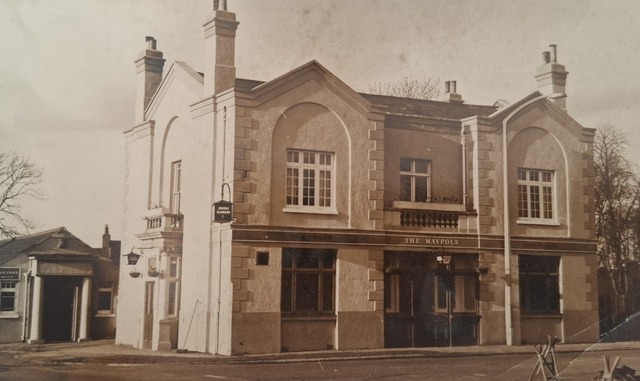
The Maypole
 |
|
|
Picture source:
Hania Franek |
|
|
|
|
The Maypole was situated
at 171 Lambourne Road. |
|
|
|
|
|
|
|
|
|
This pub has now reopened. |
|
Colin Price
(September 2014) |
|
|
|
|
|
|
|
Now closed again. |
|
Phil Gaskin
(October 2016) |
|
|
|
|
|
|
|
|
|
|
Local newspaper review by John Cutting, 1967 |
Charles Dickens, in his famous novel ”Barnaby
Rudge,” gave a full description of the King”s Head but, to suit the story,
he moved the building to the site of the old Maypole at Chigwell Row. That
inn has now been converted into two dwelling houses but the present Maypole
was erected close by just over a hundred years ago.
There is an aerial photograph in the saloon which shows clearly the relative
positions of the old and new inns. An old painting reveals that, adjacent to
the old inn, there was a pond. This was subsequently filled in, largely with
broken bottles and glasses supplied by the brewers, and the space is, today,
used by the buses as a turning-point.
Although there is no evidence to show that a maypole was ever set up where
the inn now stands, the area at the top of Gravel Lane could well have been
a clearing in the midst of Hainault Forest.
It was to such places that, in Tudor England, branches of trees and flowers
were carried in triumph to celebrate May Day. In the centre of the
procession was a high pole, painted with spiral stripes of different colours
and decked with ribbons, around which the merrymakers would dance.
Jim Tolson, now over eighty years old and a life-long resident of Chigwell
Row, was once a forest ranger. He remembers when the forest was more
extensive but, today, it is but a skeleton of its former glory and no longer
can anyone walk across the fields to Chigwell, as Dickens described.
The exterior of the Maypole looks undistinguished and the view is not
improved by an ugly out-building. This was once a skittle alley but is now
used as an additional bar during the summer months.
Inside the Maypole, however, the atmosphere is warm and friendly and the
saloon has all the charm and comforts associated with an old inn. Frank and
Win Hobby have been in charge for the past nineteen years and have drawn
around them a wide circle of friends. Frank has been connected with the
trade much of his life, for his father was once tenant at the nearby Two
Brewers.
On the wall are a couple of pictures, surrounded by post horns, which convey
vividly and rather nostalgically the spirit of the old English inn. A group
of men, one in hunting pink, are seen deep in conversation and contentedly
holding their churchwarden pipes.
In the background the landlord appears to be listening, rather sceptically,
to an angler who is proudly displaying his catch.
The other scene depicts an old shepherd in smock who sits meditating quietly
as though his thoughts still lie in the open fields. A younger man warms his
ale over the fire in a beer muller watched placidly by a homely black cat.
The bar counter is well designed and has a comfortable padded arm-rest
while, above, a delightful wrought-iron trellis is both decorative and
functional. The centre-piece is a representation of a maypole and the
attached shelves support the glasses and tankards in accessible position.
The whole display around the counter is indeed an attractive sight.
On week-days, at lunch-time, tables are laid for meals in one part of the
saloon. Various snacks are on the menu each day but Frank has, at present,
no plans to enlarge this service.
In the public bar there is a good darts board and the team compete in a
local league, but the most popular pastime enjoyed by many regular customers
is the old English game of dominoes.
Thanks to its connection with Dickens, the Maypole is well known and members
of the Dickensian Society regularly visit the inn.
Both the British Legion and Chigwell Round Table hold meetings there and
Frank, who is a past chairman of both the Essex Licence Holders Protection
Society and the Epping L.V.A., is often host to his colleagues in the trade.
Chigwell is apparently named after the number of wells in the district, and
during some recent alterations no less than three shafts were discovered in
the garden of the Maypole. The South Essex Waterworks have recently
constructed what is possibly the largest well of all as part of their
treatment works in Pudding-lane.
The beer at the Maypole is excellent. It is kept in a large cellar which is
maintained at the correct temperature by one of the numerous underground
streams which honeycomb the area.
It is probable that Charles Dickens drank at the old Maypole and he knew how
to appreciate the value of good draught.
In ”The Old Curiosity Shop” he wrote: ”Did you ever taste beer?” ”I had a
sip of it once,” said the small servant. ”Here”s a state of things!” cried
Mr. Swiveller. . . ”She never tasted it — it can”t be tasted in a sip!”” |
|
Brewers:
Ind Coope (East Anglia) Ltd |
|
|
|
The Fame of Chigwell and Chigwell Row - Facts
about The Maypole as mentioned by Charles Dickens in "Barnaby Rudge" |
While the rural beauty of Chigwell is suffering
from the activities of the builder, the heart of it on the hill by the
church remains as it was in Dickens’s day. It is pleasant to stand there and
imagine the village, a gem of the countryside guarded by the wooded slopes
of the forest, as it was in 1841, when Dickens wrote to Forster:—
“Chigwell my dear fellow, is the greatest place in the world. Name your day
for going. Such a delicious old inn opposite the churchyard—such a lovely
ride—such beautiful forest scenery—such an out of the way rural place—such a
sexton! I say again, name your day.”
The church is the burial place of Archbishop Harsnett, born in the parish of
St. Botolph’s, Colchester, who was instituted to the vicarage of Chigwell
before being elected Archbishop of York. In the year 1629 he founded
Chigwell School, where William Penn, the founder of Pennsylvania, was
educated, in the same century.
The fine old inn still opens its doors to those requiring rest and
refreshment and a glimpse of the interior described by Dickens in Barnaby
Rudge. There is evidence that before Dickens visited it with Forster it was
a boarding school known as “The White House” or “The Great House,” while on
the site of the cottages adjoining was the “King’s Head Inn.” When the
present “King’s Head” became the inn is uncertain, but the “delicious old
inn opposite the churchyard” was the old “King’s Head,” which stretched up
to the private house known as “The White House” or “The Great House.”
Undoubtedly Dickens knew the house which is now called the “King’s Head”
Inn, and in describing the Barnaby Rudge ‘Maypole” he blended its
architectural features with the actual old inn next door.
There arises the question of the site of the “Maypole,” for the position of
the present “King’s Head” does not agree with the topography in Barnaby
Rudge. In chapter one is mentioned a guest to the “Maypole” “who was the
parish clerk and bellringer of Chigwell, a village hard by,” and when
Barnaby Rudge was published there was speculation in the neighbourhood as to
the locality Dickens described. It was true that his account of the inn was
that of the “King’s Head,” but the facts of the absence of a village green
at Chigwell and the nearness of the church to the inn did not coincide with
the book. On being asked about it by his neighbour, Dickens said: “The fact
is, I patched it. The place in my mind was Chigwell Row, but I moved the
‘King’s Head’ Inn to the site of the real ‘Maypole’ as more suitable to my
story.” The old “Maypole” at Chigwell Row still exists behind the present
“Maypole” there, and is now converted into two dwelling houses. Visitors to
Chigwell should see the “King’s Head” Inn so delightfully pictured in the
tale, and then they should go to the old “Maypole” standing on the site
which Dickens had in mind when writing Barnaby Rudge. |
|
|
|
|
|
Do you have any anecdotes, historical information, updates or photos of this pub? Become a contributor by submitting them here.
Want to make contact with other customers and publicans of this pub? Add your details here. |
|
|
|
Other Photos |
 |
|
Date of photo: 1966 |
Picture source: John Cutting |
 |
|
Picture source:
Hania Franek |
 |
|
Date of photo: 2013 |
Picture source: Fergy Campbell |
 |
|
Date of photo: 2014 |
Picture source: Colin
Price |
|
|