|
Home > Essex >
Roydon > The
Crusader
The Crusader
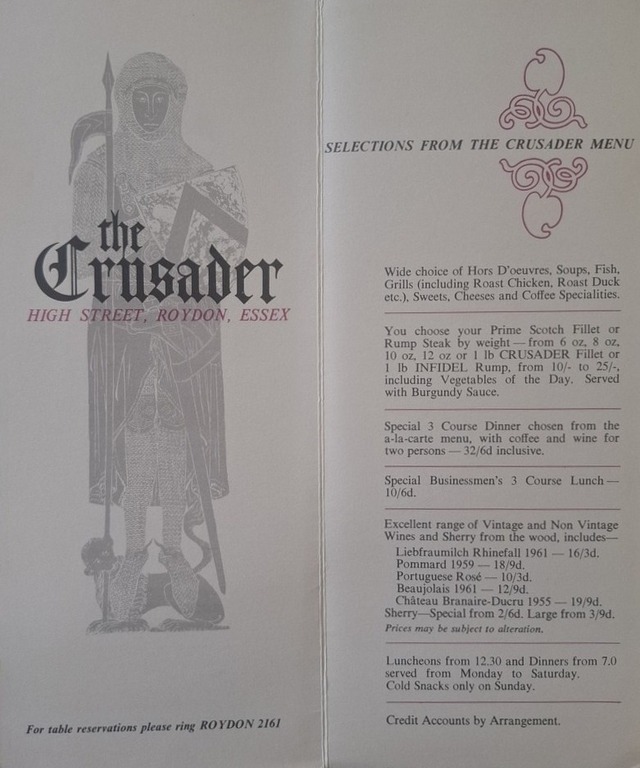 |
|
Date of photo: 1960s |
Picture source: Carol Springham |
|
|
|
|
The Crusader was situated at 42 High Street. This pub closed in 2020 during
Covid. |
|
|
|
|
|
|
Local newspaper review by John Cutting, 1960s |
|
The last man to stand in the stocks at Roydon died only five years ago but
these relics of the past on the Green together with the ruined splendours of
Nether Hall and the mellowness of the 13th Century church all conspire to
give the town the dignified appearance of respectable antiquity. Situated by
the River Stort on the Essex-Hertfordshire border, Roydon somehow manages,
moreover, to retain its rural atmosphere in the face of the encroaching
urbanisation of Harlow. |
|
It was, therefore, more than a little unexpected to discover in Roydon High
Street one of the most modern inns to be opened in the Country. The Crusader
was built only two years ago on the site of an earlier Public House which
was known as The Temple. |
|
Outside the inn there is an old hitching rail -
suitably annotated - although I am sure that no horse has yet been asked to
make use of the facilities provided. An attractive modern door leads
directly to the single bar with a well-designed counter and in the same
room, on a raised dais and discretely separated by a low wooden balustrade,
is the restaurant. |
|
The decor is original and striking. On white
wareite panels are reproductions of brass rubbings of knights and their
ladies taken from various churches all over the country. The photographic
process used has brought outclearly the details of the armour and the
dresses of the ladies and the deep blacks stand out sharply against the
white of the panels and contrast vividly with the light Swedish pine
woodwork. The same pattern is extended to the essential offices where the
doors are labelled 'Knights' and 'Damsels' with an appropriate picture for
those unable to read. |
|
Additional decoration is provided b a wonderful
exhibition of armour and weapons used during the period when wars were
considered an outlet for chivalry. The frightening appearance of a
seven-flanged mace, specially designed to be used against armoured cavalry
makes, however, this weapon, at least, appear horribly functional. Other
exhibits include a gauntlet, daggers, swords, a helmet and a circular
Saracen shield, described as having been used throughout the MIddle East,
India and Persia from the 11th to the 19th Centuries. |
|
The Manager of the Crusader Inn is Mr. Neville
Jouan and both he and his delightful wife, Inge, are experts in the trade
and are determined to raise even higher the standard of the meals. Business
lunches are served every day and in the evening the wide choice of a la
carte meals will be increased by the introduction of two or three
Continental dishes. There is an excellent cellar below the inn where a wide
range of good wines is kept and Neville Jouan intends gradually to add some
more expensive and vintage wines. |
|
To assist him he has a cosmopolitan staff which
consists of a Spanish waiter and waitress and an Australian bar-tender.
Neville, himself, comes from Jersey and Inge is German while, contrary to
normal practice, the chef is English. |
|
The striking figure which is the centre-piece of
the decoration is presumably that of Richard, the Lion-hearted, who appears
to be treating a lion cub (? a poodle) rather badly. The spirit of the
Crusaders with their accent on chivalry must surely be one of the virtues
and I am sure that Neville Jouan will approve the decoration in the Crusader
where it has been 'set in imprint to the intent that noble men may see and
learn the noble acts of chivalry, the gentle and virtuous deeds that some
knights used in those days. |
|
Brewers:
McMullen & Sons Ltd |
|
|
|
Do you have any anecdotes, historical information, updates or photos of this pub? Become a contributor by submitting them here.
Want to make contact with other customers and publicans of this pub? Add your details here. |
|
|

